
Stories from a Few Lives
Short pieces from the blog, 2009 to 2018
From 2009 to 2018 I kept a blog. Hardly anybody read it, which was probably for the best. It covers an apartment in Wichita, a kibbutz within sight of Gaza, six months of backpacking around the world, and three years in Haiti: first as a driver, then alone in a fishing village, then running a bakery. It ends with a wedding, a sailboat, and a baby.
The whole blog is 200-some posts, and a lot of it is me thinking out loud. These are the parts worth keeping: short stories, lightly trimmed, roughly in the order they happened. Each one links to the original post if you want the long version.
In 2012 I admitted to “a bad habit of signing up for new challenges.” These stories are mostly what happened next. These days I’m married with three kids and run a small business, and I still haven’t quite broken the habit.
Contents
Chapter One
Wichita, and Leaving It
2009 to 2011
In 2009 I was in my mid-twenties, living in an apartment in Wichita and owning more stuff than I wanted. I sold a 22-foot sailboat I called “a chain around my neck,” put two go-kart wheels on eBay (they went for $21.50), and later cancelled my home internet. The blog started about the same time. Most of what I wrote those first years was sermons to myself. These are the parts where something actually happened.
I’ve Really Gotta Go
Earlier this week, in one of my classes, a student suddenly blurted out, “Can I get a bathroom pass? I’ve really gotta go!”
“No.” This is my characteristic response. It’s easy for students to ask for hall passes and special privileges, but it’s equally easy for me to say no. Which I do. The word “no” is such a wonderful word.
The situation escalated. Wailing. Pleading. Begging. Mercy, just a little mercy, PLEASE! “If I can’t go to the bathroom right now, I’m gonna pee all over the floor, right HERE!”
Really? Right there? Uh-oh, this was becoming serious. Perhaps even alarming.
“Ok,” I back-pedaled. “I’ll give you a bathroom pass. On one condition. The length of time you’re gone to the bathroom is the length of time you get to stay in here after class.”
She let out an agonized cry. I can’t describe it any other way.
“So, do you still want a bathroom pass?” I asked.
“No,” she answered, with surprising calm and composure. That wonderful word “no” again. See? The students like it too.
And she didn’t even pee right there.
From the blog: I’ve Really Gotta Go!
Plan E
I needed to print thirty handouts for a presentation in my 7:30 a.m. summer class. On this particular project I had procrastinated so long I was still finishing details at 5 a.m. Then my printer ran out of ink.
Plan B: print them at my parents’ house on the way to school. I breezed in at the crack of dawn, crawled under their desk to reach the awkwardly placed USB port, and in my hurry tipped their computer over on its side. It crashed. Cold.
Plan C: their printer, my laptop. Wrong drivers. I downloaded the right drivers. Their printer still wouldn’t recognize my laptop. The hands of the clock now stood at 7:31. Class had started one minute ago.
Plan D: the computer lab in the Education building. 7:50 found me standing in front of its closed doors. Its closed, LOCKED doors. It opened at 8.
Plan E: the library, clear across campus. Also closed. But the 24-hour study room had one aging printer, with its paper tray padlocked shut. How was I going to get an A if my Fact Sheets were printed on boring white paper? They had to be on the eye-catching neon green paper I’d brought. Then I spied a copier with no lock. Insert green paper. Oops, upside down. Oops, wrong side. Why is the copier spitting out long rolls of goobered inky nastiness?
I took my seat fifty minutes late, moments before my turn to present. Just in the Nick of time. I handed out my Fact Sheets (on eye-catching green paper) and calmly delivered my presentation. The green paper had better have helped.
From the blog: A Day Late and a Dollar Short
Arby’s, We Are On to Your Tricks
I don’t eat at Arby’s much. Not that I don’t like it. It’s that I have never once gotten out of there without spending an arm and a leg, and I’m always too embarrassed to argue about my order. I just fork over the dough and make a mental note never to repeat the same mistake.
Recently I received a sheet of Arby’s coupons in the mail. On my lunch break I decided to risk it. I drove up to the menu board.
A raspy voice ensued: “garble, garble, would you like, garble, mushroom, garble, triple cheddar, garble.” I hastily interrupted. “Look, I have this coupon. C-O-U-P-O-N. It says I can get an entire meal for $3.99.”
Silence, then: “garble garble? … garble? garble?!” They were asking some sort of question. I decided to play it safe. “No, I don’t think so. Nope.” Now the voice sounded exasperated. “Are you sure? Garble, it’s free! Cinnamon, garble, and it’s FREE!”
I should have known better, but I’m not one to turn down free food, especially food with the word cinnamon in it somewhere. “Well, sure, if it’s free, toss it in the bag.”
I eased up to the pay window. Now understand, some of this story has been stretched a little, but what I’m about to say next is absolutely true. The lady opened the window, reached for my card, and said, “That will be twenty-two dollars.”
I about went through the roof. She disappeared to talk to the manager, then came back and apologized: “This is my first day on the job.” Right, I thought. You guys probably have a whole file on me in there with “sucker” written in big letters at the top.
This blog is supposed to have a spiritual focus. So the moral of this story is that Arby’s is a lot like sin: they can both cost you more than you ever think they will.
From the blog: Arby’s, We Are On To Your Tricks
The Power of Stick Shift
I got a surprise when I left work the other day: my car wouldn’t start. I’d left the headlights on at lunch, and I had a Bible study to get to.
I remembered something I’d read from John Eldredge about how a passive man says, in effect, “God will not come through.” I said to myself with fierce resolve, “Far be it from me to be construed a passive man.”
The power of stick shift is that you can, theoretically, start the car by getting it rolling really fast in neutral and popping the clutch. I pushed my car out of its stall and lined it up on an open stretch of parking lot. Did I mention I was wearing dress clothes? It started moving slowly, then faster. Soon I was literally sprinting behind the Honda. Uh-oh, looks like we’re gonna hit that Ford in about twenty yards.
It’s hard to catch a car that’s already rolling as fast as you can run. With an extra burst of speed I did a Jason Bourne, dove into the driver’s seat, and popped the clutch: glut, gluuuut, gluuuuuuuuuut. Silence. Stopped. At least I didn’t hit the Ford.
I didn’t really expect that to work. My main plan was to cause enough commotion that someone would have mercy on me. Sure enough, a very large shiny SUV came lumbering around the corner. The tinted window cracked open and a pair of eyes peeked over the top. “Do you need a jump?”
“No, I just push cars around parking lots for exerci… yes, I could use a jump, thanks for stopping!”
From the blog: The Power of Stick Shift
Did My Life Peak at Six?
The year I was six has been my favorite so far. That was 1989, the year I should have gone to kindergarten but instead stayed home (long story). Beginning my education with a gap year was thinking far ahead of my time.
Back when I was six I was into cowboys. In particular, BEING a cowboy. Every day was spent riding my bicycle (Mustang steed) around the backyard (the Bar-K Ranch), lounging in our wooden playhouse (Davy Crockett’s Alamo), climbing trees (watchtowers), and lassoing neighborhood alley cats (rogue steers).
Evenings were spent watching others work. Watching Mom get supper ready. Watching Dad get home from the office (I always hid behind the front door and leapt out yelling “Raaugh!”). And my favorite: watching Luke build stuff, like transforming Dad’s metal gasoline can into a robot (Dad wasn’t thrilled, but I was). While Luke was at school I would go out to the shed and stare longingly at his unfinished balsa-wood airplane, hardly able to wait until he got home. I wished school didn’t exist so he could work on it more. Little did I know my negative feelings toward school would only increase with time.
Back when I was six there was nothing to worry about. Definitely not the future. And nothing to stew about. Fortunately, not the past. Now, at twenty-seven, I think about both quite a bit.
Seems like childhood was one big quest to become an adult. Then adulthood becomes one big quest to regain the humility, faith, and wonder of a child.
From the blog: Did My Life Peak at Six?
The Wool Blanket
Like Luke, I knew only vaguely the virtues of wool, but had enough sense to know $9.99 was a good price, and bought one at Harbor Freight to keep in the back of my Jeep for emergencies. Good thing, too, because one time an emergency came up.
Joey and I were at Lake Afton on a blustery day and shipwrecked our Lido sailboat on the rocks. Fortunately, where we hit shore was directly in front of the only camper parked on the lake. A hardy couple were out enjoying the gale from their lawn chairs. I’m sure they were enjoying the idyllic scene of our sailboat careening around the lake at about 40 miles an hour with two screaming guys hanging on for dear life. Their day got more interesting when we careened directly into their Party Pad.
The boat was upside down and waterlogged, the mast jammed in a crevice, and the waves were bashing the hull on the rocks. The man waded in to help. Then his wife decided she would help too. I remember thinking this perhaps wasn’t a good idea. About then a mighty gust besmote us all and, I kid you not, ripped her shirt open. We all demurely averted our eyes, and she ran, mortified, back to the camper.
All hope was fading when I suddenly remembered the Harbor Freight wool blanket under the back seat of my Jeep. I excused myself from the man in the water, and from Joey, who was busy eating a Tootsie Roll or some such, and came back with the 80/20 blend. I laid it over the rocks and we heaved the Lido onto it. The man tied a rope from his pickup to the bow, and with many a crunch and a pop, his truck dragged a thousand pounds of waterlogged boat out over the rocks.
We all cheered. The lady stayed in the camper.
The boat took Joe and me the rest of the summer to repair. The blanket was unharmed, but never before had I seen a blanket so muddy. We hosed it and wrung it, over and over, and more mud kept coming. We left it in the front yard to slow-water a square patch of Dad’s grass. When it finally dried I beat it, and beat it, and beat it, and billows of dust kept coming out. It was like an old car seat that had been farted on way too many times. Finally I gave up and put it back under the seat of the Jeep.
Many moons later I drove to Turkey Hill Ranch Bible Camp for a fall retreat. It was dreadfully cold, and we were assigned an unheated cabin. I had come prepared with every accoutrement known to mankind. One of the other guys had brought absolutely nothing. No sleeping bag. No pillow. That night I watched him curl up in his bunk, fully clothed and shivering, while I pulled my zero-degree bag a little tighter and took another long sip from my steaming thermos of hot chocolate. I watched his lip begin quivering and felt a twinge of pity.
I climbed out of my sleeping bag, went out into the freezing cold, and from under the back seat of my Jeep removed one very filthy Harbor Freight wool blanket.
Was it scratchy? Yes. Like a horde of chiggers.
Was it dirty? Yes, like an over-farted-in car seat.
Was it warm? Yes, like the fires of Hades.
Was it an 80% wool Harbor Freight blanket for $9.99? Yes, and none other.
My buddy was grateful beyond words. Well, he did have a few words. He gasped, “Is this a genuine wool blanket, or at least an 80/20 blend?” I assured him it was. Soon his shivering stilled into a quiet slumber. The next morning he looked like he had slept inside a vacuum cleaner bag, but the following night he curled up in the same blanket again.
Written in 2015 for an online forum where my brothers and I were comparing wool blankets. It never made it onto the blog.
Like Finding a Wife
One of my campers cried himself to sleep three nights running. On the third night I sat with him on the bench outside our cabin. “Do you know that sometimes parents want their kids to do hard things because they think it would be good for them? Just like God sometimes wants us to do hard things?” A pause, then, between sniffles: “I’ve never heard of that concept before.” I nearly laughed at the word concept. He wasn’t homesick the rest of the week. Not sure if it was the talk or if he just got over it.
I took my cabin on a night hike to a hilltop to read Bible verses about the stars. It was so hot, and they were so hyper, and so freaked out about being in the woods at night, that my plan went by the wayside. But I managed one object lesson: “Boys, right now you’re frightened of the dark and you have to rely on me. The dark doesn’t frighten me anymore, but there are other things that do.” “Like what?” Then one kid quipped, “Like finding a wife, right?” Ten-year-olds can be perceptive.
By the time we got back one boy had skinned his knee, another was limping, and I was carrying a third piggyback. The next day: “Nick!! Can we go on the night hike again? That was the most totally awesome thing ever!” The answer was no.
One of my boys came from a hard background and spent most of the week in trouble. At one point I thought he might have to go home early. By the last couple of days he had changed. I even saw him break down and cry, and this was one tough little dude. On the last morning he gave me a big hug and asked me to write down my contact information. I did, on a scrap of paper. When I saw him later getting into the van for home, he was still clutching that piece of paper.
From the blog: 21 Highlights and Lowlights of Camp Counseling
By 2011 I was restless. I’d been to Haiti once on a short mission trip, I had money in the bank, and I had a job I was, as I put it then, “ambivalent towards at best, and downright weary of at worst.”
The First Try
I remember more than one night lying in bed late, feeling restless. Getting up and going for long walks around the pond at my apartment, the one with the fountain in the middle. Thinking, “I’m tired of here. Maybe I should take a trip. A big trip. Maybe there’s a hungry kid on the other side of the globe whom I could give a lunch to. Maybe I would see reality clearer. Maybe I would see God!”
One night I mustered my resolve, packed my car with a sleeping bag and several cans of beans, and hit the road. But I got sleepy in western Kansas and pulled over in a field to rest. Next morning I drove back to work and reality.
So much for that. But then I really did it.
From the blog: Around the World in 180 Days
Gate D33
On my way to Haiti I talked with a Haitian man named Vuther in the Miami airport for several hours. His house had been destroyed in the earthquake, with no insurance. Since then he and his wife had started a school in their home for neighborhood kids too poor to go anywhere else. His wife quit her job to teach full time. He wouldn’t take money from outsiders; he wanted it Haitian-run. He had put his own three children in it to give it legitimacy.
His dream was to help 100 kids get a good education. Just 100. I asked, “What about 1,000?” He laughed and waved me off. “No, no, just 100. That’s all.”
I was so engrossed in talking (listening) that, after a couple of hours steeped in gab, I failed to notice no one else was in my waiting area. What finally reminded me was a complimentary phone call from American Airlines.
“Mr. Middleton, where are you?”
“Um, here in the Miami airport, why?”
“Where in the airport?”
“Sitting here at Gate D32?”
“WHAT ARE YOU DOING THERE? You’re supposed to be at D33, and this is the last call for boarding to Port-au-Prince!”
Have I ever mentioned I’m absentminded?
From the blog: Having a Vision as Big as Vuthers
Adoption
At an orphanage we visited, two little boys basically adopted ME the first minute I walked in. Job didn’t smile much. It took something pretty big. When he got an entire box of crayons, his face lit up like someone had given him a million dollars. Every time I got up, even to take a picture, he would get up and bring me back to sit next to him.
Nickelson had been at the orphanage seven years. He watched out for the younger ones. On the last day we talked through an interpreter. I asked if there was anything he was looking forward to. He said oui. When I asked what, he said, “Adoption.”
From the blog: Haiti–Jumbled Impressions
A few more from these years
- In a Wichita blizzard, the Wendy’s drive-thru lady was incredulous I’d ordered a Chocolate Frosty. I assured her it was only fitting, considering how frosty it was outside. →
- One week I locked my keys in my car three times. Rather than pay a locksmith $55, I broke into my own car in the laundromat parking lot with a Slim Jim, cut my finger, and got some strange looks. →
- At the California border: “Are you transporting any fruit or vegetables?” I pointed at the sandwich I was eating. “Well, this has tomatoes in it.” I added that there were two more in the trunk. She waved me through. →
- A Utah trooper: “You were going 66 in a 50, Boss.” He let me off with a warning, then told me not to worry about my speed. “It goes back up to 65 just ahead.” →
- In the Dominican Republic I wrote in my prayer journal that I really wanted a pizza. That night we ate at a restaurant on the beach whose menu was almost a full page of pizza. →
Chapter Two
The Kibbutz
Israel, 2011 to 2012
In December 2011 I flew to Israel to volunteer on Kibbutz Nir Oz, a farming community in the Negev. I fed calves at 5 a.m., hitchhiked to Jerusalem on weekends, and walked the Galilee with a backpack. Among the volunteers I was the only American.
Near Oz
Despite the name, Nir Oz is actually nearer to the Gaza Strip. In fact, I can see into Gaza from here.
The other volunteers are from all over: Wales, Britain, Germany, Poland, Holland, South Africa, Italy. The kibbutz is like a self-contained unit in the middle of nowhere-ville. I feel like I’m on an Amish settlement.
There was an old dilapidated bicycle by our house that didn’t work, so I spent my free afternoon fixing it, and after a trip to the machine shop I am now the proud owner of an old blue rusty BMX bike. I wasn’t so successful fixing one of the girls’ curling irons.
There is also a camel here. Apparently they found it wandering in the nearby fields and captured it. If no one claims it in the next month, they’re going to keep it. They think it might be pregnant.
From the blog: Kibbutz Nir Oz
Abraham’s Well
My Polish friend Tomasz and I followed his guidebook to the ancient well Abraham supposedly dug. The map led us directly to a sidewalk pastry café.
The proprietor spoke basically zero English, so I ordered by pointing, then tried asking about the well. No clue. I showed him the guidebook, with the X right over his pastry shop. Was he hiding the well out back? Still nothing. Finally I pantomimed pulling a bucket of water up from the ground. He became quite excited and pointed across the street.
We had already looked there. Turns out the well was behind a makeshift wall in a construction zone. We found it by climbing up and peering over. Who knows? Maybe it was the very one Abraham dug.
From the blog: Be’er Sheva
Christmas Eve in Bethlehem
The night before, the hostel owner didn’t honor my reservation. He said it had been for a mattress on the roof, and it was raining. So I had the opposite problem of Mary and Joseph: instead of the stable, he gave me a private room, at four times the price.
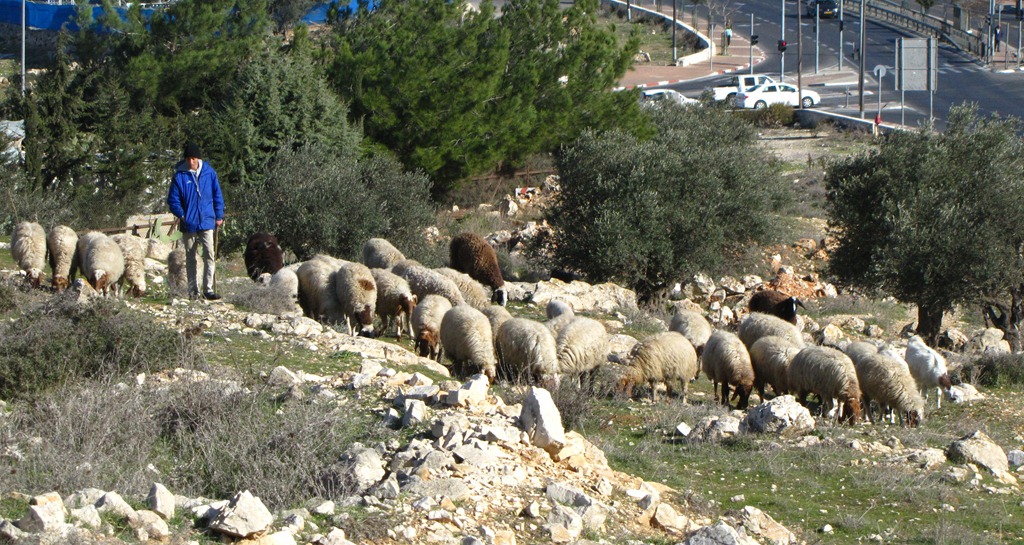
Three of us walked the six miles to Bethlehem: me, Tomasz from Poland, and Merle from Germany. Halfway there we passed a young shepherd watching a small flock on a hill. His staff was straight, with no crook. Tomasz said this was because of animal-rights concerns. I theorized shepherds had finally run out of crooked sticks.
Manger Square was a madhouse. We set out for the Shepherds’ Fields, got a ride from a kind couple who wished us Merry Christmas, and found what was waiting for us there was pretty exotic: a group of Japanese tourists.
On our way out of town we passed a Lutheran church starting an evening carol service. A group of young Palestinians sang carols they had practiced, all in Arabic. It wasn’t professional, which made it seem more like home. The whole thing was so pleasant I fell asleep at the end.
Then we walked back along the wall in the dark. It was raining in earnest now, and we were freezing. My favorite memory of that day is walking along that graffiti-covered wall in the rain, singing Christmas carols with Merle, she in German and I in English.
From the blog: Christmas Eve in Bethlehem, 2011
A Treatise on Baby Calves
One of my jobs is feeding the calves. Most drink from their bucket with no problem, but some won’t drink at all, so it’s part of my job to learn them. I could bottle-feed the stubborn ones, but then, from ever onwards, the cuddly critter expects a hand-fed bottle instead of drinking from its designated bucket, as good little cows should.
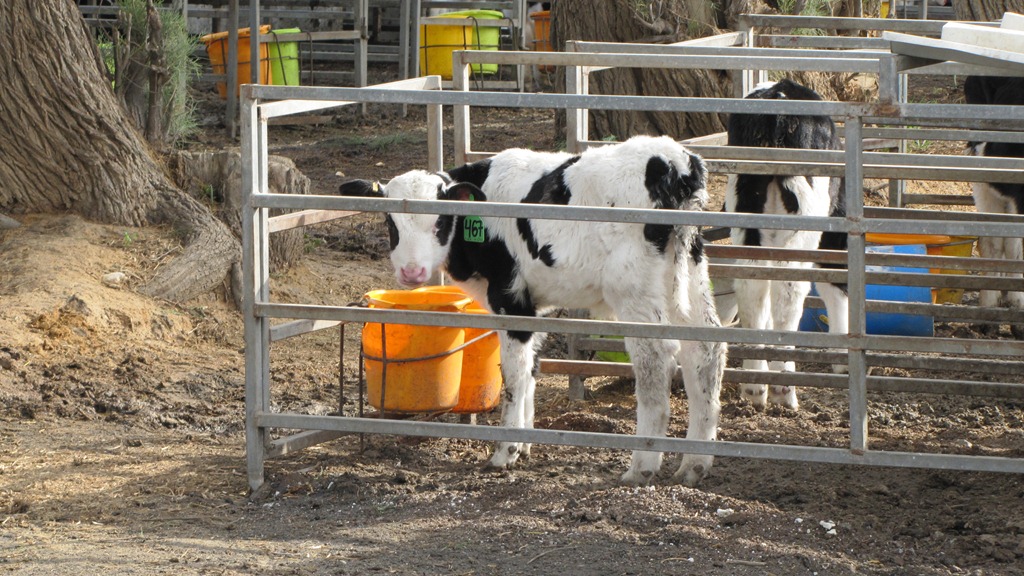
Sometimes they just loll their tongues from side to side and jerk their heads as if they’re wholly insane, and they probably are. This means a testing of my patience as hasn’t been seen since the days of Job.
I saw one drinking so eagerly he wasn’t paying attention to his back end, which got stuck between the poles of his cage. He ended up stretched out long-ways, head in the bucket hanger, back legs outside the cage. It was so funny I couldn’t stop laughing. I helped him get untangled, which he was very thankful for, but I still gave him a stern lecture on the risks of drinking while driving his back end.
I’m mightily surprised at how routinely they poop in their food bucket. My cow book says cows have a keen sense of smell and are exceedingly picky about their food. After watching them, I think that book must have been written by an enterprising Hindu.
My cow book also says cows have a great memory. I’ve observed their memory to be off by about half a second. Every morning they put their heads down into the bucket hanger right before I lower the bucket in, and get bopped on the head. This I do with glee, admittedly. They never learn.
From the blog: A Treatise on Baby Calves and their Tendencies
On the Jesus Trail
Halfway up the Mount of Beatitudes, trying to get into the mood of the Sermon on the Mount, I spied an unrobed, bearded, hobo-looking man at the water’s edge taking his monthly bath. This ruined the historic atmosphere, to say the least.
In Capernaum, someone in the fourth century decided a certain house had been Peter’s and built a church over it. Centuries later someone built a mosque over that. The original house is now encrusted in so many layers of religious baubles that I passed it by and saved my shekels for cans of Coca-Cola instead.
In Cana I walked by a bakery and the Arab owner began enticing me inside, in the persistent manner they are wont to do. Usually I desist, but the chocolate-filled croissants were calling my name. He asked where I was from and what I was doing. I told him. Then, amazement upon amazement, he filled a bag with pastries and refused any pay. May a blessing come to that man and his progeny to the tenth generation.
Hitchhiking back to Nazareth, I mentioned to the Israeli driver that I’d seen the ruins at Bethsaida. “Oh! Did you see the arch with the pagan god engraved on it?” He pulled up his sleeve and showed me a large tattoo of that god. “Some people are Christians and worship Yeshua, and others are Muslims and follow Mohammad. Me, I’m a pagan.”
From the blog: Hiking in the Footsteps of Jesus
Levinsky Park
Asylum seekers from Darfur, South Sudan, and Eritrea were living in a park by the Tel Aviv bus station. I went with a ministry to help hand out dinners, about 500 of them, and to talk with anyone who spoke English.
One man, Michael, had a degree in computer science. He had been living in the park two months. He asked if I had any computer books, because the only book he had was a Bible. He was reading the Gospel of John slowly, paragraph by paragraph. He said he was reading an English Bible instead of an Arabic one because it was “those” people who had killed his family.
From the blog: Asylum Seekers in Levinsky Park, Tel-Aviv
A few more from these years
- Israeli pop cans are made of thicker aluminum, so I always think there’s more left than there is. I’m continually disappointed. →
- There is no Dr Pepper in Israel. I joined the Facebook group “Bring Dr. Pepper to Israel!” as its third member, pending approval by the admin. →
- At the Ramon Crater, two women asked the hostel owner for a restaurant. “There’s a great one where you can get pita and a big bowl of hummu…” “Not huuumus!” Later: “Is there anything to do around here?” “Well, you could hike in the crater.” “No, we don’t want to hike.” →
- Tomasz and I went camping in the Negev, which gets about an inch of rain a year, and got rained out. The next day we met geology students who had driven down from Jerusalem to see what a desert rainstorm does, since it almost never happens. What did they expect? A Middleton showed up. →
Chapter Three
Around the World
Egypt to Hawaii, 2012
From Israel I kept going: Egypt, Ethiopia, Kenya, a day in Venice, Indonesia, Japan, Hawaii. Thirty flights all told, and twelve countries. By Ethiopia I was writing, “I’m becoming cynical of humans.” Some of the better stories came out of that.
Mount Sinai
The big thing the Bedouins sell at Mount Sinai is a camel ride to the top. About every ten steps someone asked if we would care for a ride, with a seller strategically placed at the top of every difficult stretch. There were enough camels on that mountain to transport a small army. Our guide practically raced up. I’m convinced he was trying to wear us out so we would buy one.
Getting stuck behind a camel on the trail is like getting stuck behind a semi on the highway. You keep peering around its backside to see if there’s room to scamper past.
At the top, one in our group hadn’t paid for their tea, and the Bedouins made a stink about it. So I volunteered to be the sacrificial lamb who paid twice, covering the transgressions of the Judas and silencing the murmurings of the Bedouins.
We had an hour to wait for sunrise. My Welsh companion Matt debated whether it was appropriate to sneak a smoke. I told him it wouldn’t be the first time fire had rested on this mountain, and that it would probably be OK. He lit up. I read about Moses and the burning bush, which the monastery below still has on display, it having conveniently never burnt up.
From the blog: Climbing Mount Sinai
The Pyramid Police
Right after I bought my ticket, an official-looking man asked to see it, took it, and told me I had to hire a camel or a horse to see the pyramids. Walking was against the rules. He was not lying, he said. He was not affiliated with the stables. He was, in fact, the Pyramid Police. I had already read about this scam online. I pointed out the tourists walking around and politely asked for my ticket back. By the end he was quite angry with me for all my pains to be polite.
Later a camel man named Abdul offered me a ride starting at 300 pounds. I sat at the base of a pyramid refusing while he kept coming down. At 60 I caved. I ended up paying 145 through high-pressure guilt, but it was an hour on a camel around the pyramids, and the money went straight to the man who owned the camel.
On the way back, Abdul told me my ticket included one of the smaller pyramids. I clambered down a long, low passage into the burial chamber, alone. Perched on a stone shelf above the empty sarcophagus, I popped open a Coca-Cola I’d bought from a man with a cooler in the middle of the desert (without dismounting the camel), and wondered whether a can of Coke had ever been opened in that tomb before. If the mummy were still in there, I bet it would have rolled over.
From the blog: Visiting the Pyramids of Giza
The Bad Samaritan
A kid kept insisting I exchange his Euro coins into Ethiopian birr. Then an internet-café owner ran up, and another kid with more coins. “Internet! Euros! Change! Please! Ferenge! You! You! You!” Finally I spun around in the middle of the road, looked the first kid right in the eyes, and said, “Look! I am NOT a European, so I don’t need Euros. In fact, I am AMERICAN.”
As I was explaining this to him, I noticed his eyes. They were severely crossed, one turned inward, just like mine. He was about thirteen. And he did need new shoes. He walked off.
Of course, then I felt awful. Yes, I AM American. And because I’m American, when I was thirteen like that boy I was having my second operation to get my eyes straightened. At thirteen, this kid is trying to scrape together enough to buy shoes. At the time, though, I didn’t feel bad enough to go back and exchange his paltry Euros. I’m a Bad Samaritan.
Another day two boys insisted on guiding me up a mountain to a monastery. One of them, Tilouse, kept wiping his eyes; they had watered since he was born. His friends told me he was very clever in math, and he wants to be an engineer. As we came down the mountain he looked at me with this big grin and said, “I am soooo happy!” Then he wiped more tears away.
His family was too poor to take him to the hospital in Addis Ababa. I could have stayed and helped, but it would have meant days on buses, and that would have been inconvenient, you know? So Tilouse will probably have eye problems his whole life. I’m a Bad Samaritan.
From the blog: The Bad Samaritan
On Top of the Truck
From Moyale to Isiolo I rode on a transport truck loaded with bags of corn, three levels deep, from 8 a.m. one morning to 7 a.m. the next. The first fourteen hours were on one of the worst dirt tracks I’ve ever been on. For hours we moved at walking speed, jounced around like we were on a mechanical bull.
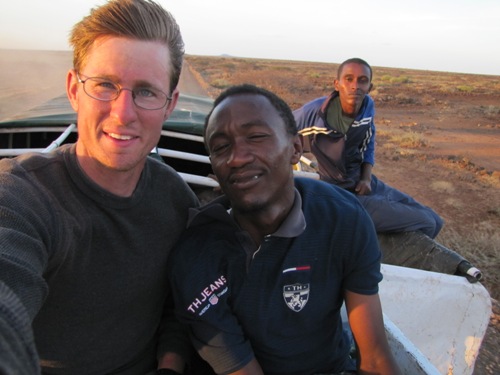
Most of the time I sat perched on top of the roll cage. At the start there were eighteen of us up there. By evening, five. I sat out late watching the stars while the truck toiled on through the bush. There were no city lights anywhere. I finally felt somewhere totally remote. Parts of it were miserable, and all in all it was a blast: probably the closest thing I’ll ever experience to a covered wagon.
From the blog: On the Move
Three Butter Knives
By Lake Naivasha there were hippos walking along the water’s edge. I set my camera on a fence post to take a picture and, while fiddling with the controls, touched the fence. It was electric, and it royally zapped me. I think the voltage was set for hippopotamuses, not humans.
The next night I splurged on a lodge in the Aberdares, where you watch elephants and Cape buffalo from a bunker by the waterhole. At dinner the butlers watched my every bite, whisking plates away the moment my last finger was licked. I had three butter knives. Not three for the table; three for me. They only gave me two rolls, so even one knife per roll left one unused. Perhaps the third was for cleaning my teeth? I hated to experiment, so I left it daintily on the table, pristine.
From the blog: Crazy Safari
Leeches and Bats
I spent several weeks with a missionary family among the Moi, a highland tribe in Papua with no roads in, only an airstrip notched out of a mountainside. One day five Moi men took me on a “picnic” down to the river, an hour each way, on a trail that varied between a 45-degree muddy angle and an 80-degree muddy angle. They went barefoot. I slipped, slid, fell, and turned into a giant sweat blob.
At the river I pointed out my first leech to the man next to me. Unconcerned, he picked up a sharp rock from the beach and scraped it off my leg, leaving a bleeding hole where its slurping head had been. Thanks, bro, for passing on that stone-age technique.
Then one man crept under an overhang where bats were dozing, while two others waited outside with sticks. Out came the bats. Whap went the sticks. They roasted two and popped them in their mouths whole, minus the wings.
Later I set up solar panels for the new church and had to fill the batteries with acid, which a good part of the village found interminably interesting. When I cut the tip off the first bottle with a knife, several warriors jumped back. Perhaps someone had warned them battery acid was harmful. But what about poor me, who was opening the noxious things?
From the blog: Clashing Civilizations
Tokyo
The first time I saw a man in slacks and a collared shirt cleaning a spotless Tokyo sidewalk, searching for a stray candy wrapper to remove with a pair of salad tongs, I stopped mid-step, mouth open, and stared.
Most places I’ve traveled, showing the slightest hesitation is like blood to piranhas, so I’ve trained myself to look like I know where I’m going. In Tokyo I decided to test it. I pulled out my map, walked in circles on the sidewalk, squinted at street signs, and stared at the map in complete befuddlement. Locals walked by as if I were the invisible man. Nothing.
But buy a bottle of water at a gas station, and the checkout man jabbers at you in what appears to be a rapture of delight, bowing repeatedly. I felt honored.
From the blog: I Thought I’d Seen it All, Until I Saw Japan
Welcome Back
Walking toward immigration at the Honolulu airport, I realized I could understand the conversations around me again. The first one was a man complaining: “They just built this wing, you’d think they could have made the moving sidewalks a little faster!” Only in America do we complain about the speed of the moving sidewalks.
A week later, at my brother Seth’s, my six-year-old niece Kailee cried because I couldn’t stay longer. Then she put a note on my pillow: “I’ll miss you uncle nicky,” with big red hearts, and at the bottom, “Nick and Kailee alwis togethr forevr.” She also reminded me I had written her only one postcard in six months. Yes, traveling the world is good. But having family back home who fuss over you a little is also good.
From the blog: The Shocking Semantics of Culture Shock and I Feel Welcomed Back!
A few more from these years
- In Ethiopia, the first word I heard from a human one morning came from the hotel cleaning lady: “Money!” “What?” “Money!!” →
- In Dahab I haggled a scarf down from $30 to $4, then put my arm on the seller’s shoulder and asked what his situation was. His mask dropped. I was his first customer of the day. It was 9 p.m. →
- My bus companion Fish had never eaten pizza, and still hasn’t; he ordered spaghetti because cheese wasn’t allowed during his fast. →
- The adjustment knob on my $10 Wal-Mart watch broke off in Egypt. By Bali I was adding six hours to whatever it said, and felt sorry for the people beside me on buses who leaned over to check the time. →
- In Jakarta a young woman asked to have her picture taken with me, and then so did her entire extended family. Someday her great-grandkids will flip through the album and ask, “So who’s the white guy?” →
Chapter Four
The Driver
Port-au-Prince, 2012 to 2013
In December 2012 I moved to Port-au-Prince as a volunteer driver and handyman for Heartline Ministries. That meant airport runs, a 1992 4Runner that had “put itself out there,” and fixing whatever was broken, which was everything. Haitians have a proverb for it: Dye mon, gen mon. Beyond the mountains, more mountains.
Safety 5th
Driving is not nearly as bad as I expected. That’s not to say I haven’t nearly hit someone, more than once, or knocked the driver-side mirror off the Montero. I did. The rules are simple. An inch is as good as a mile. The right of way goes to whoever gets there first. Cutting is not considered rude; it’s considered merging. Or winning.
Everywhere one looks in Haiti, something needs fixing. The fan in my room blows copious amounts of air but is missing its grill, and I have it set up blowing right on me while I sleep. I’m not a little apprehensive that some morning I’ll stick my head into the blades while turning off my alarm clock. Free lobotomy, here I come. In America I’ve seen many posters that read “Safety 1st!” In Haiti they should make posters that read “Safety 5th!”
This week a company put up an eight-foot concrete wall for us. The blocks weren’t mixed right and have the consistency of chalk. I can crumble them with my pocketknife. I pushed on the middle of the wall and it swayed back and forth.
From the blog: Driving in Port-au Prince, Haiti
Li Ampil Malad
I drove a young woman with dengue fever to the airport. With a cold compress on her forehead she staggered into the van, and she cringed at every pothole.
At the airport we were swarmed by the usual luggage “helpers.” Three came up, vying for business. I looked at them seriously, pointed to the sick girl, who at that moment was vomiting into a bucket, and said, “Li ampil malad.” She is very sick. Suddenly they didn’t want to help us so much anymore. I gave the biggest guy a few dollars, and he did.
On one narrow road, traffic in both directions came to a standstill because two drivers going opposite ways had stopped to visit through their windows.
That afternoon the 4Runner’s front left brake caliper stuck. It pulled so hard to the left that if you let go of the wheel, it just spun. By the time I got home, the back tires were spinning gravel just to move forward in first gear. Keeping up with repairs here is like that arcade game where you whack the rubber heads, and the faster you smash them, the quicker they pop back up.
From the blog: A Detailed Summary of my Saturday
Things One Sees
One morning on an airport run, a truck loaded with sugarcane was beside me, four men perched on top. A haggard man came up and demanded a stick. They refused, so he held them up with a rock. They still refused, so he threw it. One of the men stood up on the load and began swinging a sugarcane stick at his head.
About this time one of the guests in my car asked whether the UN would intervene in this type of aggression. As luck would have it, some UN soldiers walked up at that exact moment. The haggard man yanked out a piece of cane and went on his merry way while the soldiers watched, doing nothing. So I told our guest, “Apparently not.”
A rat once jumped out from under the hood of our car. Our yardman chased it with a stick and, with all of us cheering him on, dispatched it promptly. Another day I was stuck in the middle of several projects, none going well, when he walked by muttering, “Problems on problems.” I said, “You can say that again.”
We needed tile, so I went to a materials store with a display rack of samples. I pointed to one. Do you have this in stock? No. I pointed to another. No. I pointed to every tile on the rack. No, no, no. So what did they have? They took me to a dark, musty back room with one size of tile, in one color, piled in boxes. I bought a few.
From the blog: Things One Sees in Haiti
A Very Steep Hill
Detours sent us through rough backstreets in our box truck, loaded with most of a 22-person work team. We came to a steep hill of loose dirt and potholes. My heart sank. The pickup ahead of us tried, got stuck, backed down, tried again, and churned up the hill fishtailing and shooting rocks out behind.
We couldn’t turn around and couldn’t back up. I stuck it in first and gunned it. Stuck halfway. We rolled back down. A Haitian man came over and assured me we could make it. Same result. He came over again: we could make it, if only we got a bigger head start. I figured he had probably been sitting there all day watching who made it up and who didn’t.
So once more I revved the engine, and in a mushroom cloud of dust, nearly stopping once while the tires spun and the truck careened around, we crested the hill. Everyone in the back started cheering like crazy. They were probably just glad to be alive.
That evening I listened to the team recount their week. None of them mentioned the hill. What really freaked them out was a U-turn I made beside a 40-foot drop-off. I wasn’t concerned about that one. We had plenty of room.
That week I also got my first ticket, for driving with people riding on top of the box truck. Why the police ticketed me and not every other vehicle on the road with passengers on top is a mystery.
From the blog: A Tale of a Very Steep Hill
My Day Off
Many aspects of Haitian life are intense. Sometimes Haitians drive their cars like maniacs. Sometimes they worship the Lord like maniacs. On my day off I witnessed both.
In the city cemetery, a massive tree had a great number of voodoo dolls pinned to its trunk. In retrospect I should have asked my guide what they were for. Instead, I remember telling him I’m a Christian and don’t believe in that pokey-needle-jazz.
That evening I went to my friend Watson’s revival meeting. Most of the Haitian sermons I’ve heard are delivered in the same emotional tenor: imagine Tony Evans speaking Haitian Creole. Except that he’s on steroids.
Driving home, I was stopped at a police checkpoint over a burned-out headlight. One officer wanted a bribe. Another wanted to throw the book at me. Then a third came up and asked, “So what do you want us to do to you?” How are you supposed to answer that from an officer of the law? “Just give me a warning and let me go.” Eventually they did. Ask and you shall receive.
Downtown I passed a mob of perhaps a hundred people running down the street, yelling, some carrying torches. I gave them a wide berth. Then a concrete barrier loomed out of the dark, directly across my lane. I stopped just in the Nick of time, as is my custom.
From the blog: What to Do on My Day Off?
Towed
Filling stations in Port-au-Prince have been out of gasoline for five days. That’s three million people with no gasoline. They say an oil tanker from Venezuela is two weeks late. Probably Venezuela forgot to send out the boats after Hugo Chávez died.
Then the Montero’s freshly repaired starter quit at the hardware store. Pierre towed us halfway across Port-au-Prince with the pickup while I steered the Montero with no power steering and no power brakes. At one point Pierre drove off the road to avoid an obstacle, without slowing down. Ryan, riding with me, couldn’t watch. He kept staring down at his phone.
Another day a policeman wanted “a little something” for a burned-out taillight. One ploy is to pretend you don’t know Creole. Unfortunately, I know some, and when he asked for “de mil gourde,” about $50, I about went through the roof. We both stalled for five minutes. He let me go with only a warning.
From the blog: More Driving Stories
Wedding Cake
I was given the job of driving the wedding cake to the church, an hour away. The Heartline ladies had made it: three tiers, quite impressive. It rode in the cab of the pickup, along with four Haitian ladies and me.
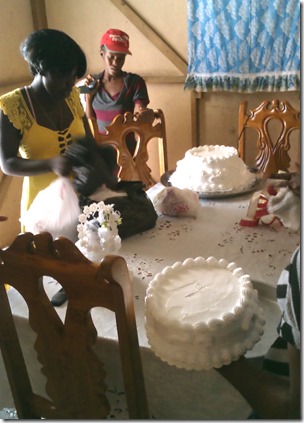
At the site, the cake was carried into the bridal suite, a plywood structure converted for the occasion. The base was set down. The top was set down. The middle tier was still being carefully held by an unnamed person. Moments later, disaster struck. Right under my nose, it flopped out of her hand and landed ker-plop on the cement floor.
After the ladies recovered from their heart attacks (I may have covered my mouth in dismay), they tried seeing what the cake would look like demoted to two tiers. I thought it looked great. Who needs three levels anyways? Then, to my surprise, they set about fixing the ruined one. I wondered about germs from the concrete floor, but if we’re following the three-minute rule it was probably still OK. Their skill reminded me of the part in Ernest Goes to Jail where Ernest whittles a machine gun out of a bar of soap.
On the ride home the humor set in, and I was regaled with peals of laughter from the back seat. The only girl who never snapped out of her deep funk was the one who dropped it, sitting next to me in the front seat. But I won’t reveal her name.
From the blog: Wedding Cake
Frank
I met a German tourist named Frank at the grocery store. He told me, in broken English, that he had come to Haiti looking for a wife. He had even put up a sign outside his hotel: “One man from Europe looking for a woman to marry,” with a phone number.
Later, back in Germany, he emailed to say that sadly he hadn’t found one. He had been introduced to three ladies, but none worked out. The deal-breaker with one was that she had, in his words, “the face of a man.” I would have thought not being able to speak a word of each other’s language would have been an earlier deal-breaker, but what do I know? Perhaps communication in a marriage is overrated?
Another day I passed a motorcycle towing another motorcycle with a piece of twine. I mentioned it to the Haitian lady with me. “What do you expect, you’re in Haiti? Keep looking and you may see a dog towing a dog.” I’m still watching for that one.
From the blog: What Will Happen Next?
A few more from these years
- Running through the Dallas airport on the way down, I reached the gate as the door was closing, under a mountain of luggage, and was the last passenger aboard. Just in the Nick of time. →
- Half asleep, with mosquitoes chewing on me, I grabbed what I thought was lemon-eucalyptus spray and doused my head. It was 100% DEET. No more bites that night. Perhaps cancer next week, though. →
- My official physical for residency consisted of checking that I had a pulse. →
- I was flushing a toilet by pulling a string the same week I read about a Japanese Bluetooth toilet that keeps a poop diary. →
- A man came to the back of our tap-tap with a boy who seemed to be blind. Everyone in that tap-tap was poor, and they took up a collection anyway. →
- At an outdoor market I found a brand-new baseball cap for three dollars. At home I saw the bill was sewn on crooked: a factory reject, sent to Haiti as a charitable donation, for me to find in a box at the market. I still wear it. →
Chapter Five
The Village
Ravine Sèche, 2013
In June 2013 I moved to Ravine Sèche, a fishing village north of Port-au-Prince, to learn Creole. For $150 a month I rented a concrete house with a tin roof, an outhouse, and a rain barrel. I was the only blan for miles. “For someone who dislikes being the center of attention,” I wrote that first week, “this is a bit of a challenging situation.”
Immersion
It is night time now. Rain is softly falling on my tin roof. An oil lamp is warmly lighting my room. And I’m safely underneath a mosquito net.
The sounds of people talking on the porch waft through my house. A little ways off, a child is crying. Everywhere I hear Creole. Several hundred people live in this village, and I have yet to meet one who speaks good English.
Kids sit outside my door. Parents want to talk. The pastor came by: would I be free to come see his school tomorrow? The fishermen are discussing who gets to take me out fishing first.
In each room of my house, voodoo fetishes hang from the ceiling. I keep meaning to cut them down, but they’re kinda high. Whatever they’re good for, they do a lousy job of neutralizing mosquitoes.
The storm has moved in closer, and peals of thunder now roll across our valley. The village has quieted down. The noise will begin again tomorrow, bright and early.
From the blog: Immersion
Fee-zee
A neighbor told me that to fish really well I needed “fee-zee.” I guessed he meant physique, as in muscles, and told him, “Yeah, I’ve got that.” He got quiet, leaned in, and asked, “Where?” I went and got my dictionary. Fee-zee means rifle.
The next day I went on my first fishing trip with the locals. I thought it would be a few guys, one boat, a little while. It was ten of us, two boats, nine hours. The nets were cast twice. Long naps were taken at anchor. The biggest haul was a drowned cat another fisherman donated to our cause, which my compatriots were happy enough to receive, though the smell of it roasting under my seat made me wish we had thrown it back.
After seeing Haitian fishing techniques, I will now sleep easier for the safety of all the little fishies around my village.
From the blog: In Which Nick Gets Sunburnt
Sighting a Foreigner
It was about 10 p.m. I was helping as cashier in the little canteen my landlord, Ironce, runs right outside my door. The music was blaring but cutting in and out, because the radio controller was an antiquated piece of junk. Ironce had borrowed my screwdriver and, between that and a butcher knife missing its handle, was fixing it once and for all. The tiny generator whined in the background, revving up and down for no apparent reason, and the single lightbulb brightened and dimmed in cadence.
A drunk man was loitering at the window. Out in the dirt street, a young man with Down syndrome and a burly beard was performing a thoughtful jig to the music. One foot out, other foot out, arms in a robot dance now.
Into this melee an athletic-looking, obviously uncomfortable, tall Hispanic man in slacks and a white tank top appeared at our window. The boys informed me he was a Dominican. Darline, Ironce’s wife, concurred loudly over the music: “He’s a Dominican!”
A moth landed on his arm, then his face, and he swatted wildly. Over the din I picked up “dos… noches…” Darline handed him a mosquito candle through the window, around her working husband on the inside and the drunk on the outside. Money was passed. No change was given. He looked perplexed. I think he wanted two candles, or change. Darline gave neither. He started to argue, but nobody could hear him, assuming anybody was paying attention, and nobody was. Eventually he backed away and disappeared into the night.
Ironce bumped the wrong wire and the music quit. In the sudden quiet the drunk, without ever having turned his head, said the obvious: “The Dominican left.”
I felt sorry for him. He was obviously a foreigner in this environment, and in a way I was the insider. Then Ironce “fixed” the music, and I couldn’t hear myself think again. If you can’t beat them, join them. A group of us went into the street and danced with our friend.
From the blog: Sighting a Foreigner
Was God at Church?
During Sunday school the pastor kept talking directly at me, slowly, repeating himself so I would understand. Then he got tired of me sitting incognito in the back row and moved me to the front. The VERY front. Every time my concentration lapsed I would hear “Nee-koe-LAH!” and look up to see Pastor checking on my attentiveness.
The night before, a young man and I had gotten into a discussion about whether Noah in the Bible was a black man or a white man. He thought white. I attempted a lesson on genetics and the origin of the races, which, considering I speak about ten Creole words, was tricky. Then Pastor loomed out of the dark, and the young man excitedly posed the question to this recognized spiritual authority. After deliberation, Pastor declared the Bible was silent on Noah’s nationality. Tout moun pa konnen. Nobody knows. I figured I did know, but didn’t press the point.
I asked what time church started. There was some argument among the bystanders. Pastor thought 7:30 would be good for me, but under pressure gave in to 7:45, and eventually conceded 8:00 would probably be early enough.
I showed up at 8:00. The church was empty except for Pastor, one lady, and her two small kids. Next week I’ll come no earlier than 9:00, when everyone else shows up. I wouldn’t be surprised if God arrives closer to 9:00 too.
From the blog: Was God at Church?
Pè and Pye
I was out by the ocean, where I get good cell reception, making a phone call home. Two of my teenage sidekicks came up breathless to warn me I was in great danger. “What danger?” “From a wicked malefactor.” “What malefactor?” “The werewolves.” Everyone in the village had gone inside early. Then they hightailed it back themselves.
My new roommate, Noë, began pulling on my arm, insisting we go back, NOW. Reluctantly I went. Everyone was indoors, an odd and unfamiliar scene for Ravine Sèche. One neighbor had his whole family sleeping together in one of his two houses. I didn’t feel any evil presence. It just seemed like a bunch of people had creeped each other out.
The next morning, on the way to the well, Noë introduced me to the oldest person in the village. He said she was 107. I didn’t believe it. Noë said I could ask her myself. We hurried to catch up, and she spoke first, loudly, cocking her head: “So, you guys heading down to get water?” I had secretly hoped that at 107 she would have something more profound to say. More like Yoda.
I asked her how old she was. “What?!” Louder. “Oh! I’m 107 years old.” “See?” said Noë.
I still wasn’t convinced. “Well, the way I know she’s so old,” Noë added, “is because she has a daughter who is an old, tiny, frail thing.” He hunched over and twisted his arms in a dinosauric fashion. “In fact, she looks a lot worse than her mom.”
Between malefic werewolves, a lady hobbling around at 107, and getting my flip-flops re-stitched by the official flip-flop cobbler, I’d say today was a success.
From the blog: Pè and Pye
The Other Side
A medical team from America came to Ravine Sèche for a one-day clinic. I didn’t know any of them. They blew in setting up tables, opening a pharmacy out of suitcases, snapping pictures. You can always tell newbies to Haiti, because they’re dressed for a safari. Were they hiking somewhere afterwards, I wondered?
I watched from under a shade tree with a group of locals. One man told me, “I have asthma and need a new inhaler, but I’m going to wait for the line to die down.” That seemed reasonable. It was a nice shade tree.
One of the team asked me what I do here. Well, you’re seeing it. Today I’m watching you guys work.
The leader asked if I could get lunch for twenty-two people. My friend Darlene agreed to cook rice, beans, and chicken for $50. I felt that was too low, so I pitched it to the leader at $70. Surely a group of doctors could afford it, and surely Darlene needed the extra $20 more than they did. Afterwards I had a pang of conscience. I had just done two things that annoy me constantly: taking them to my friend instead of the best cook, and charging them more because they could afford it. I offered the leader the difference. He wouldn’t take it. And in the end she cooked fish instead of chicken, which was probably less appetizing for those who got the heads.
A boy of about seven had a serious problem, so I knelt down to talk with him. I asked if he knew who I was. “Wi, ou se blan Mayse Nicolas.” My reputation precedes me. After we talked about his problem, he asked me why my toe had a Band-Aid on it.
While we waited, one of the kids told me he was looking forward to making watermelon juice with me later. I said, “Want to start now?” “Nah, let’s wait until after the blans leave.” That’s the thing. Blans leave. Even me, someday.
From the blog: The Other Side
A Long Wait
The pastor and I visited a family one morning. When we were ready to leave, they pressed us to stay for rice and beans. I knew we were in for a bit of a wait.

Their place was on the beach, so we pulled plastic chairs under a shade tree and waited. And waited. After two hours I saw three men get in a boat and row away. They had no net, so they weren’t fishing. Someone offered that I could go with them, but I declined, because I was waiting for my rice and beans. An hour later they came back with fish they had bought at a market. When the ladies started scaling them, I knew we were in for an even longer wait.
Four hours after we sat down, we were served rice, beans, fresh bonito, and a cold Coca-Cola. It was really delicious, and by then I was hungry. For a while I watched some fishermen play cards, but they got tired of that and rolled over to take a nap.
When was the last time you waited four hours for a meal? Some days here I feel like Huckleberry Finn.
From the blog: A Long Wait
Back from the Morgue
While I was visiting an American couple, they got a call that a Haitian friend of theirs had died at the hospital. The wife went straight to the widow’s house to mourn with the family. That evening she came back with the craziest news. While she was there, the morgue had called: the mortician noticed the man was still breathing, so he was sending him back to the hospital.
The next day a group of us went to pray with him. Middle-aged, bearded, he didn’t look well, but he could talk. On the way out my friend remarked how sickly he looked. I countered that he looked pretty well off, considering he’d been in the morgue the day before.
From the blog: Short Anecdote
Ou Komanse Kòmik
There were a number of weeks out here I didn’t smile or laugh much. But good ol’ Nick is returning. The way Darline put it: “Ou komanse kòmik.” You’re becoming funny. I’ve reached the point in the language where I can sometimes tell a joke and have people laugh.
It helps to learn how everyone is related, which is to say nearly everyone. Now, instead of “that old guy I find kind of intimidating,” I think: “That is Darlene’s father, Darlene being his only child by his first wife, who is the gentle older lady yonder who is a stalwart in the local church and one of only six going on the church’s annual evangelistic trip later this month, not to be confused with his second wife, who is more domineering and lives in St. Marc.”
Nothing can be miserable forever, humans being so adaptable.
From the blog: More at Home
Thankful
Some days I feel beat by the multitude of interactions in a foreign language, the physical discomforts, the lack of privacy. One day I even started a blog post about it. It’s still on my desktop, half written, titled “Haitians Annoy Me.” Instead, I’ve been trying to think of things I’m thankful for.
Today six friends drove up from Port-au-Prince to visit. They brought lunch, and before leaving they prayed over me. What really blew me out of the water was a gift from Anachemy, my Haitian-American friend from Port: Cheez-Its, granola bars, Jelly Bellies, taffy, Dr Peppers, Vanilla Cokes, and even Oreos. I was eating the Oreos thinking, “Gosh, these are amazing, I should buy more of these sometime,” then saw the price tag: $10 US. And remembered why I don’t usually buy them.
My life is rich. So what if there are a few bug bites along the way?
From the blog: Thankful
A few more from these years
- On rainy nights, open the outhouse lid and the inside is lined with cockroaches. Some scurry back down. Some run around the room and over your toes. →
- We fished a dead, decomposing lizard out of the bottom of my water tank. →
- Enochson, my fifteen-year-old constant shadow, was insulted to learn what Food for the Poor means in Creole. “We’re not in poverty! Those beggars in St. Marc, now they’re in poverty. Not us.” →
- When I turned some teenage boys out of my house for a little time alone, they called me a “wicked, mean person,” and in nearly the same breath asked if they could cook spaghetti on my stove. →
- A girl visiting from St. Marc was said to be deeply in love with me. I said, “What? I just met her today.” I was assured she had known ME longer. →
- On a short trip to Venezuela I drove over the big bridge in Curaçao more times than I wanted, because what looked like the exit ramp was really the “do it again the other way” ramp. →
Chapter Six
The Bakery
Port-au-Prince, 2013 to 2015
After a couple of months back in Kansas, I returned to Haiti in November 2013 to oversee Heartline’s new bakery and a discipleship program for young men. That meant early mornings at the oven, payroll, a rusty Toyota pickup, a 125cc dirt bike, and a great deal of time at the bank.
If They Don’t Say, I Get to Choose
Coaching our cashier at the bakery window:
Customer: I want a bunch of that bread.
Cashier: We don’t have that.
Me: Why did we just tell him we don’t have that?
Cashier: Because the bread he wants won’t be ready for another hour.
Me: Then we tell him it will be ready in an hour, or offer him bread he can buy right now. Our answer to customers is never “No.” It’s always “Yes!”
The next customer handed over several small bills without saying anything. Our cashier took them and punched in an order.
Me: How did you know what she wanted?
Cashier: Well, she didn’t say, so I chose for her. If they don’t say, I get to choose.
Ah, I see.
From the blog: Hitting the Ground Stumbling
Finding Small Change
Many stores in Haiti don’t have change. Hand a cashier a 1,000-gourde note (about $25) and they look at you as if you were a snake: “Nou pa gen monnen!” We don’t have change! I decided a hallmark of our bakery would be always having change. First I had to find some.
I sent workers out to find coins. They came back like Noah’s doves, with little twigs, when I was expecting fresh rolls of coins in cardboard tubes. A man on the street offered to supply all our change needs, at 120 gourdes for every 100. How often could he do this? “From time to time.”
So I put Moise, my co-worker, on the back of my motorcycle and went to a bank. The line was about 75 people long. The manager said they didn’t have enough change. At the next bank I was ushered into the back office of the Grand Pumba himself.
“We can split that 1,000 into 50s for you.”
“No, we want coins. Two hundred 5-gourde coins.”
He leaned back and laughed. “We have no change in this bank.”
“So when the government mints coins, where do they go?”
“I don’t know.”
“In my country, they go to banks.”
“We aren’t in your country,” he chuckled. Obviously this blan knew nothing about how things work in Haiti. “If you want coins, go to the gas stations. They give us cartons of coins every day.”
“What? So you DO have coins!”
“No. We send them down to the National Bank.”
“And where do the gas stations get their coins?”
“From the tap-tap drivers.”
Moise was about to melt through the floor in embarrassment. “So the National Bank collects coins from the banks, who collect them from the gas stations, who collect them from the tap-tap drivers, who collect them from the people. Where do the people get their coins?”
The Grand Pumba admitted I had him on that one.
At the first gas station, the attendant had no coins and suggested I try a bank. “Well, guess what? We just visited two banks, and they told us to visit you guys! Isn’t that a hoot?” And we took off for the next station.
From the blog: Finding Small Change in Haiti is an Uphill Battle
Bakery of Charity
An orphanage asked if we could donate bread for the kids’ Christmas dinner. On Christmas Eve I bought six platters of rolls, about 300, and asked Bilhah, our cashier, to call and confirm where they were. She couldn’t reach them, but Wilson knew where the orphanage was and could deliver it.
That afternoon I asked Wilson how the drop-off went. “I didn’t take the bread. Jovany did.” I asked Jovany. “I didn’t take it. Carl, our security guard, did.”
Two days later I found Carl. “Did you deliver the bread to the orphanage?” “Yes, I can do that.” “No, not can you. Did you?” “Oh yeah, I did that.” “How did it go?” “They didn’t say anything.” Carl added, “I didn’t actually go to the orphanage, because I don’t know where it is.”
“So where did you take it?” “To the grocery store. I gave it to Merlin.” “Who is Merlin?” “Oh, you don’t know who Merlin is? He was the contact I was supposed to give the bread to.” “Did Merlin say thanks?” “No, because Merlin wasn’t at the grocery store. I gave it to Merlin’s brother.”
I went back to Bilhah. “Were you ever able to reach the orphanage?” “Oh yes.” “Did they say anything about a man named Merlin?” “No.” “What did you tell them?” “That we would drop the bread off at their place.” “And who delivered it?” “Wilson. He’s the only one who knows where it is. Because… he knows the lady.”
The next logical question was “Which lady?” But I decided to stop while I was behind. As I left, wondering whether our bread for orphans had gone to the brother of a mysterious necromancer named Merlin, Bilhah chirped up: “It’s really not an orphanage, you know. It’s an organization that takes care of kids…” By then I had tuned out.
From the blog: Bakery of Charity
Twelve Bolts
At the hardware store, the bolts were sorted haphazardly into old plumbing-part boxes with the labels scratched out. At the counter, the cashier measured each one by holding it up to her index finger. Then she informed me I couldn’t buy just one of each. I needed six of one type, four of another, and twelve of the third. I found more of the first two, but there weren’t twelve of the third. If they only had one bolt left, I couldn’t buy it, because I had to buy twelve.
Finally I asked: could I please buy twelve, and they only give me one? With hesitation, she agreed.
Another day, while my A/C was being worked on, a windshield-wiper salesman decided I needed new wipers. I said no repeatedly. I got between him and the car and said no firmly, and he reached around me. Finally I pushed him away. I went back under the hood, and when I looked up a minute later he had installed one of his wipers on my car. I pulled it off, threw it across the parking lot, and yelled at him to get lost. He stopped laughing after that. But there could have been better ways to handle the situation besides losing my temper. I felt bad afterwards.
Being here in Haiti, I feel like I’ve lost whatever veneer of holiness I used to think I had. The truth is I’m the same person, but frequent duress means I get to see my true colors far more often than I did back home. It’s humbling.
From the blog: A Few Frustrating Anecdotes from My Life
More Bank Fun
This time I had the reverse problem: about 1,000 small bills I wanted to change into large ones. This should be a piece of cake, I thought. The banks are short of small bills; this will be a boon for them.
Visit 1: The clerk looked at my piles of small bills in horror. “We don’t have any large bills at the bank.” I could deposit it all, though. “What’s your account number?” I didn’t know it. “Come back another day.”
Visit 2: After twenty minutes of counting, the deposit was made. “Fini!” “Not quite. Now I’d like to withdraw the exact amount I just deposited.” More horror. It was against bank policy to deposit and withdraw on the same day.
Visit 3: After an hour in line, withdrawal slip filled out: “You can’t withdraw with a slip. You must write a check to yourself.” I had thought to bring my checkbook. It held only the deposit slips; the checks were in my backpack at home. “Is there anything you can do?” “Nothing,” she said, ringing the bell for the next person.
Visit 4: The line was too long, so I didn’t bother.
Visit 5: The bank had closed early.
Visit 6: I finally made my withdrawal.
From the blog: More Bank Fun
Kelson’s Finger
One of our young guys got the end of his little finger caught in a van door. My bandages soaked through twice, so I put him on the back of my motorcycle with a rag pressed to it and asked where the nearest hospital was. “By the artisan market.” Before the market, or after? “Oh, it’s IN the artisan market.” I was skeptical, having been to that market many times.
After a labyrinth of side streets we found a two-story hospital. Bystanders told us it had been closed a long time. At St. John’s, the lady at the pharmacy window asked Kelson to take off his bandage. He started with the rag. That was all she needed to see. Try St. Damien’s. At St. Damien’s a nurse began looking at him just as I got a phone call about our pickup not starting. When I hung up, we were being ushered out. They didn’t have surgeons. Try St. Luc. St. Luc sent us to Doctors Without Borders, hidden back in a neighborhood through flooded streets.
There they gave Kelson a bed and fresh gauze, and told us to take a number. They had run out of numbers. So we were told to wait without one.
In the end they kept him overnight, stitched him up, and scheduled surgery to pin the bone, for about $20. They hadn’t charged anything for the x-ray or the night’s stay. Yay for Doctors Without Borders! I’m getting an education in Haitian healthcare, if nothing else.
From the blog: My Brush With Hatian Healthcare
The Self-Proclaimed Liar
I know a man who runs an orphanage out of his home. Let’s call him Jean. He kept asking why the blans who visited didn’t support him. After deflecting this for months, I decided to be honest. “People see your need, but they don’t trust you. We think you’re shady.”
“What?! Why would anyone not trust me?” “Well, for starters, because you lie.”
He took this in stride. “Yes, I lie, but I only lie to help the kids. I say the children are younger than they are, so people will be more sympathetic. When I ask an organization for rice, I tell them I have a big orphanage so they’ll give me many bags. That’s how I lie for the kids.”
“Don’t you call yourself a pastor? What does the Bible say about lying?” “The Bible is full of liars! Abraham lied about his wife being his sister. Twice. Jacob: big liar. David, oh, big, big liar. All the big men of God lied. It’s what they did.”
“And what about Jesus? Did he lie?” A long pause. Then, emphatically, with a finger raised: “He is the only one who didn’t lie.”
I told him that if he would promise not to lie to me anymore, I would see what I could do to help. A lengthy pause, then a loud groan. “Uggh, I can’t promise that! But I’ll promise to pray that God helps me say the truth more.”
Our relationship has improved markedly since I told him I think he’s a crook. I feel like Frodo trying to cut a deal with Gollum.
From the blog: In Which I Meet a Self-Proclaimed Liar
Water-Skiing
One rainy-season evening, traffic was light and I was bee-bopping along on my motorcycle at about 30 mph through knee-deep floodwater. Two jets of water shot out from the sides of my front tire. It felt like water-skiing. I was so happy I wanted to shout.
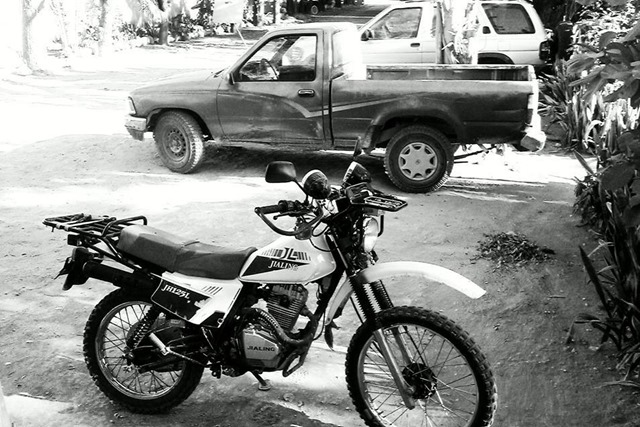
My dirt bike is only 125cc, not enough power to do a wheelie. Unless, as I found out, the rack is loaded with more than its 22-pound limit, like a couple of 5-gallon water bottles. I gave it a little too much gas starting off, and the bike flipped over backwards on me like a bucking horse. Neither I nor the bike was hurt, only embarrassed, though I couldn’t stop laughing.
From the blog: My Poor Truck & Motorbike
Gergens
Today Port-au-Prince is protesting gas prices. The tap-taps are on strike, there are burning tires at the intersections, including outside our gate, and reports of rocks thrown at any car brave enough to venture out. Since my employees couldn’t get to work, I closed the bakery.
Midmorning, one of my bakery workers, Gergens, walked in, sweaty. We hadn’t been able to reach him. “I’m sorry, the bakery is closed today.” He didn’t seem surprised. I asked what time he had left home. 5 a.m. It was now 10. He opted to go back home instead of waiting for a free lunch.
From the blog: Protests Over Gas Prices
A few more from these years
- Riding home at night I came upon a voodoo parade: perhaps 1,000 people, dancers in white paint, ghastly costumes looming out of the dark. I switched sides and went the wrong way around the divider. →
- At our first baptism, held at a public swimming hole on a Saturday afternoon, a rowdy fellow did a cannonball almost on top of the man being baptized. By the third baptism, the whole pool had stopped to watch. →
- Haitian spaghetti uses ketchup for sauce and sliced fried hot dogs for meat. I eat it for breakfast most mornings. →
- I set my alarm for midnight to run a load of laundry when city power came on. It wasn’t on. At 1 a.m. it was, so I put a load in, went back to bed, and watched city power click back off. I’m on day four of trying to get one load clean. →
- I bought an electric mosquito zapper shaped like a tennis racket. I think the mosquitoes have learned that when I’m holding it, it’s time to hide. →
- Visiting an injured worker outside visiting hours, I sweet-talked my way into the hospital. Then they thought I was a patient and wouldn’t let me leave without seeing a doctor. →
- On my day off I sprayed ant poison around my bathroom, which on the Sabbath was a double whammy: it was both work and destroying lives. →
Chapter Seven
Afterward
2015 to 2018
Anachemy, the friend with the $10 Oreos, and I were married in May 2015: once at my home church in Kansas, and once on a beach in Haiti.
Two Weddings
Someone told me that now that I’m a married man I need to change the name of my blog from simplefollower to complicatedfollower. He especially noted there was nothing simple about two weddings. I agree.
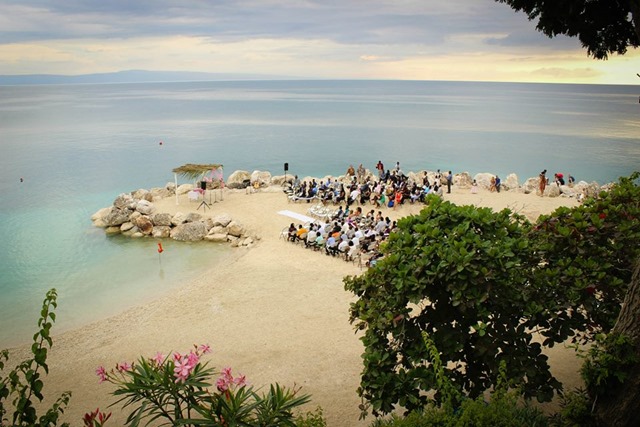
It’s one thing to visit Haiti for a week-long mission trip. It’s another to have your wedding there. About 250 people showed up. Even the president of the country watched a bit of it. I don’t know why, but President Martelly came by the beach that day.
It was a team effort. A donor paid for the beach. Heartline provided food and transportation. John McHoul officiated, with Pierre translating, and sometimes, for the fun of it, John spoke Creole and let Pierre translate him back into English. My security guard helped make cupcakes. A friend loaned us his car, and it got creamed by a motorcycle while we were driving it.
Troy was my best man. My other groomsman was Enochson. I met him in Ravine Sèche, and he’s become like a little brother to me.
From the blog: A Wedding in Haiti
A Flashlight
We decided to start married life in America, in a new place. That left 48 options. One evening in Haiti, Anachemy and I got on our knees and asked God, if he wanted us in St. Petersburg, to confirm it by providing me a job. Housing had already been provided. The very next day I was contacted for an interview at a company minutes from that housing.
I was working in Haiti right up until the Sunday I got on the plane. The next morning was my first day back in corporate America. Funny thing is, I’ve worked harder volunteering than I ever did as an engineer. This job is a good fit, though. It’s a small company where I get to wear multiple hats, I’ve never had a computer with three monitors before, and they gave me a flashlight for checking parts. Any place that gives its employees a flashlight has to be a winner.
From the blog: Transitions
Yes! Let’s Do It!
Our landlord gave us three weeks’ notice. One evening we were lying in bed searching listings on our phones. My wife was fighting down vomit from morning sickness (even though it was evening; apparently morning sickness hadn’t got the memo). A brilliant idea crossed my mind. “Why don’t we buy a sailboat and live on it?”
She very enthusiastically gave me a thumbs up while jumping out of bed and running to the bathroom to throw up. When she returned she excitedly added, “Yes! Let’s do it!” I count my blessings for having found such an adventurous woman to share life with.
A week later we found a Hunter 31 that had been used by a sailing school. It had central air that didn’t work, an autopilot that didn’t work, a fridge that didn’t get cold, and a toilet leaking effluent on the ground. We looked at each other, nodded, and offered $7,900 cash on the spot. No survey was done, both because we didn’t have time and because I could see for myself the boat was a floating pile of deferred maintenance.
On the maiden voyage to our new marina, the engine overheated above idle, and there was not a hint of wind. Ten hours later, after motoring 25 miles at idle, we pulled into our new slip.
From the blog: New Adventures
Noah
On January 30, 2018, after thirty-six hours of labor, Anachemy gave birth to our first child, a son, Noah. We brought him home from the hospital to a boat. Not many babies can say that, but considering his name, it was fitting. Jesus had a manger; Noah gets a bilge. Sort of. He’s technically above the bilge.
Before he was born I envisioned a cuddly baby who would fall asleep in my arms. I can count on one finger how many times that has happened. Since his entry into the world he has been like a heat-seeking missile: squirming, grabbing, biting, head-butting, kicking, and chewing on everything he can reach. And his reach is increasing. One of his favorite targets is my beard.
Overall, it is a joy having Noah. Yes, it’s lots of work. Yes, he annoys me a lot. But he is also super cute, and generally a very happy kid. I guess I’ll keep him.
From the blog: Noah
That’s where the blog ends. Since then there have been more moves, two more kids, a business, and another boat, but those stories haven’t been written down here yet.